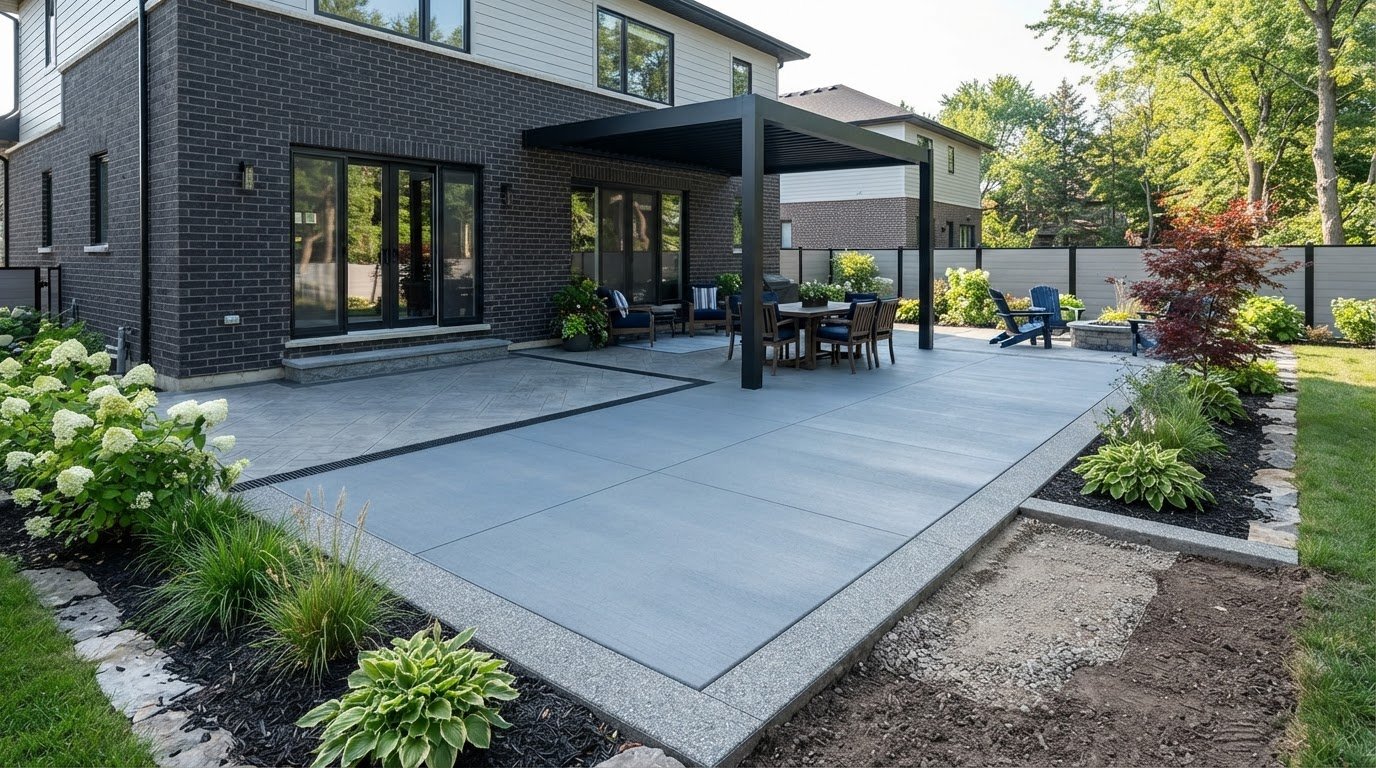
The secret to a driveway that survives decades of punishing Canadian winters has surprisingly little to do with the finish on top. In reality, most premature cracking and settling begin deep beneath the poured surface. If you’re planning a concrete driveway installation, it’s completely natural to worry about frost heave, proper slab thickness, and whether a crew might rush the unglamorous groundwork before the concrete truck arrives.
You deserve total peace of mind knowing your investment will endure harsh seasonal freezes and heavy daily traffic. This guide walks you through the entire concrete driveway installation process, from subgrade excavation and granular base compaction to reinforcement grids and cold-weather mix standards. We will outline the critical structural benchmarks and the exact questions to ask your builder, giving you the knowledge to build a reliable, crack-resistant driveway with complete confidence.
Key Takeaways
- Deep subgrade excavation and heavily compacted granular material form the critical foundation that protects your slab from harsh frost heave.
- A quality concrete driveway installation relies on rigorous permitting, precise formwork, and elevated rebar grids rather than speed or surface shortcuts.
- Air-entrained concrete mixes engineered for cold climates are essential to prevent winter spalling and withstand aggressive freeze-thaw cycles.
- Selecting the right finish allows you to balance outdoor curb appeal with essential winter traction and practical maintenance needs.
Why Subgrade and Base Preparation Dictate Driveway Longevity
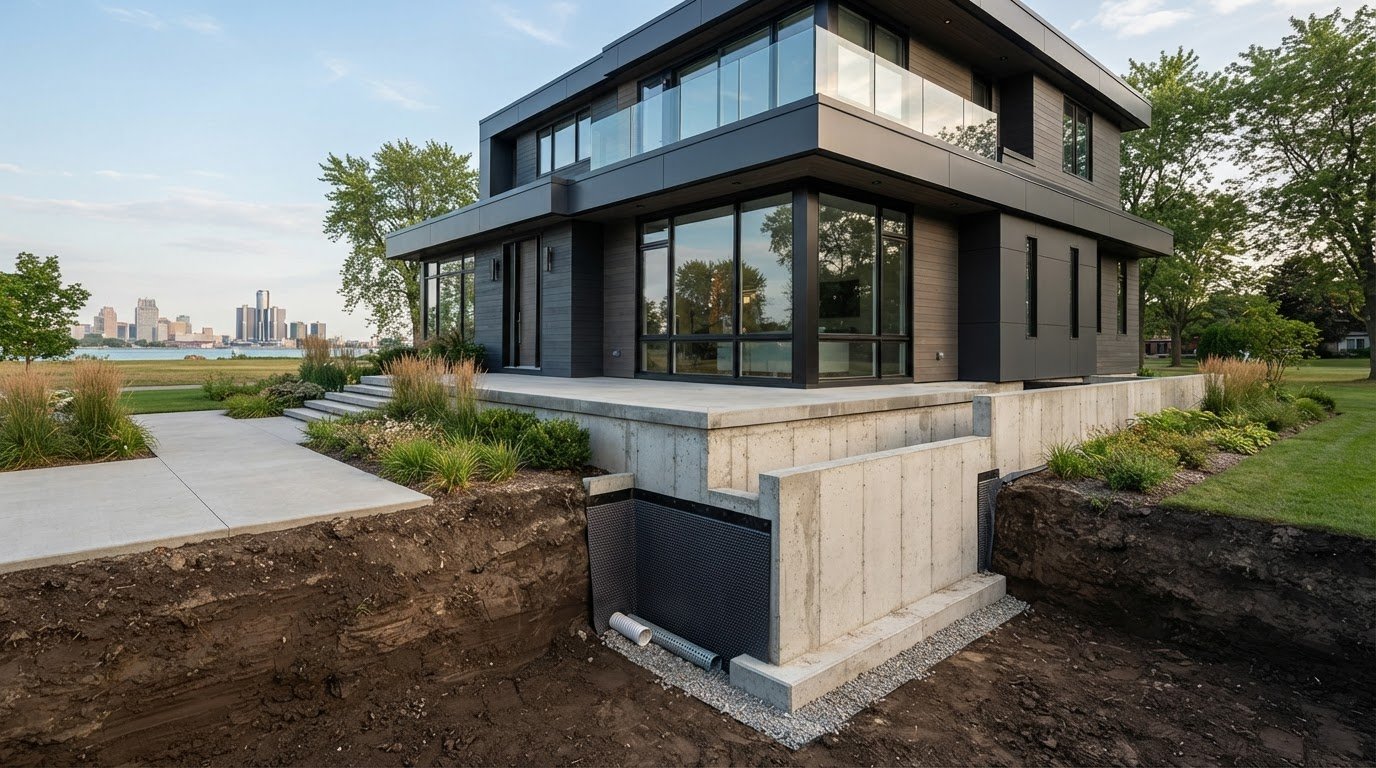
A flawless surface is meaningless if the earth underneath gives way. Successful concrete driveway installation always begins well below ground level, because a slab is only as stable as the ground supporting it. While understanding what concrete is made of helps you appreciate mix strength, the underlying base determines whether that concrete survives decades of seasonal frost heave without shifting or cracking.
Excavation Depth and Native Soil Assessment
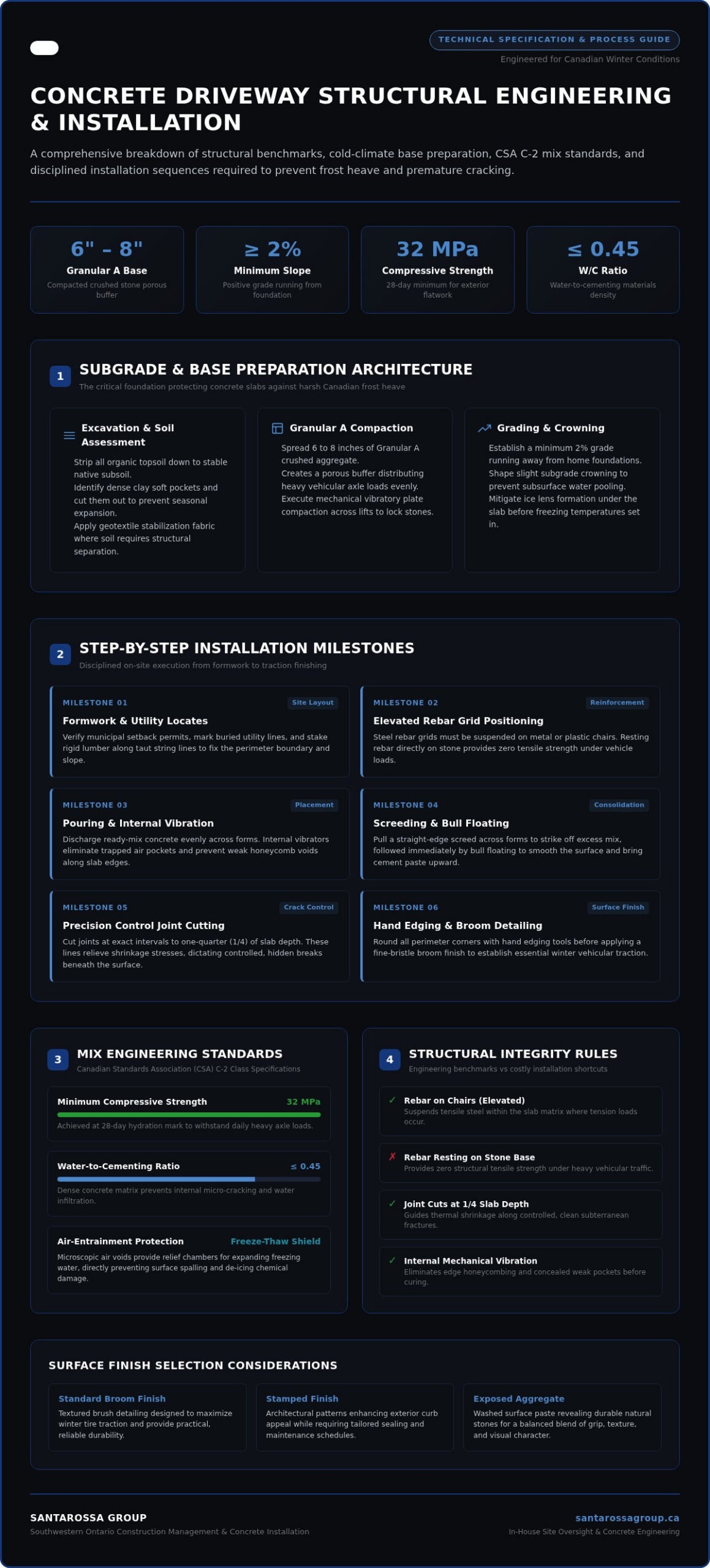
Durable construction starts by stripping away all organic topsoil down to stable native subsoil. In regions with dense clay, soil expands when wet and shrinks when dry, creating immense upward pressure during winter freezes. Proper site work involves identifying soft pockets, cutting them out, and applying geotextile stabilization fabric where necessary. Crews also establish a minimum 2% grade running away from home foundations to ensure positive surface and subsurface drainage.
Crushed Stone Compaction and Drainage Grading
Once the subgrade is level and graded, installing the right aggregate base is critical. For cold climates prone to severe deep-freeze cycles, industry standards call for a robust granular crushed stone base:
- Granular A Stone: Spreading 6 to 8 inches of crushed stone creates a porous buffer that distributes heavy axle loads evenly across the subgrade.
- Mechanical Compaction: Running a heavy mechanical vibratory plate compactor across aggregate lifts locks stone particles into place, eliminating settling pockets.
- Subgrade Crowning: Maintaining a slight crown prevents water from pooling underneath the slab, mitigating ice lens formation before the concrete arrives.
Taking time to manage these ground-level details through complete in-house site oversight guarantees your concrete driveway installation stays level for decades.
The Step-by-Step Concrete Driveway Installation Process
Once the base is prepped, a disciplined installation sequence transforms raw site materials into a rock-solid vehicular surface. Following precise construction milestones protects your project from avoidable structural flaws.
Formwork Alignment, Reinforcement, and Pouring
Before a single cubic metre of material arrives, formwork and steel must pass a thorough inspection:
- Formwork and Utility Locates: Crews verify municipal setback permits, mark buried utility lines, and stake rigid lumber along taut string lines to fix the perimeter slope and boundary.
- Rebar Elevation: Steel rebar grids must sit suspended on metal or plastic chairs. Laying rebar flat on the crushed stone aggregate provides zero tensile strength when vehicles park on the finished slab.
- Pouring and Consolidation: Ready-mix concrete is discharged evenly, while internal vibrators eliminate trapped pockets and prevent weak honeycomb voids along the edges.
Surface Consolidation, Edging, and Broom Finishing
Finishing requires meticulous timing as bleed water evaporates and the slab begins its initial set:
- Screeding and Floating: Finishers pull a straight-edge screed across forms to strike off excess mix, followed immediately by bull floating to smooth the surface and draw cement paste upward.
- Control Joints: Crews cut control joints at precise intervals to one-quarter of the slab depth. These lines dictate where shrinkage stresses relieve themselves, creating hidden, organized breaks beneath the surface.
- Broom Detailing: Hand edging rounds every perimeter corner before a fine-bristle broom creates a textured surface that maximizes winter tire traction.
Executing each milestone correctly ensures your concrete driveway installation stays level under daily vehicle weight. If you prefer comprehensive in-house coordination from site layout to curing, partner with Santarossa Group for seasoned Southwestern Ontario construction management.
Concrete Mix Engineering and Curing for Ontario Winters
Surface spalling and crumbling are not bad luck. They stem directly from specifying the wrong batch design. Surviving cyclical winter freezes requires precise mix chemistry, controlled hydration, and strict adherence to Canadian Standards Association protocols.
Compressive Strength and Air-Entrainment Standards
Exterior residential flatwork facing freeze-thaw exposure and de-icing chemicals requires concrete that meets CSA C-2 class specifications:
- Compressive Strength: Slabs require a minimum 28-day compressive strength of 32 MPa alongside a low water-to-cementing materials ratio of 0.45 or less. This dense matrix withstands daily vehicle weight without micro-cracking.
- Air-Entrainment Chemistry: Field testing must confirm an air content between 5% and 8%. These billions of microscopic relief chambers allow frozen capillary water to expand safely inside the hardened slab instead of popping the surface off.
This level of structural engineering mirrors the rigorous standards applied to residential concrete foundations across Ontario properties.
Moisture Retention, Curing Protocols, and Sealing
Pouring the right batch mix is only half the battle. Concrete does not simply dry; it hydrates chemically. Applying a curing compound or damp burlap sheeting immediately after the initial broom pass traps crucial moisture inside the slab. This controlled hydration prevents surface crazing and early shrinkage fractures.
Homeowners must keep passenger vehicles off the fresh pour for at least seven days, reserving full heavy truck loads until the complete 28-day cure cycle finishes. Once cured, a breathable penetrating silane-siloxane sealer blocks de-icing salts from penetrating the pores while still permitting trapped vapour to escape.
Ready to engineer an enduring slab for your property? Plan your concrete driveway installation with our specialized team to protect your exterior surfaces through every winter freeze.
Choosing Between Standard, Stamped, and Exposed Finishes
Selecting your driveway texture is an exercise in balancing curb appeal with Canadian winter realities. While visual styles vary, your choice directly impacts everyday tire traction, snow clearing, and routine maintenance.
Comparing Durability, Maintenance, and Slip Resistance
Each decorative finish delivers unique functional benefits:
- Standard Broom Finish: The traditional choice for residential driveways. A textured broom surface provides dependable, non-slip vehicle and foot traction through snow and slush while requiring minimal maintenance over its lifespan.
- Exposed Aggregate: Washing away surface paste uncovers decorative stone aggregate below. This pebbled texture creates deep visual dimension and natural slip resistance, though it requires a fresh protective sealer every two to three years.
- Stamped Concrete: Replicates the premium look of natural stone or cobblestone pavers. Because stamped impressions can catch sharp snowblower blades, homeowners often apply fine slip-resistant additives into the sealer. It also pairs cleanly with matching concrete patios to unify front and backyard hardscaping.
Selecting Professional Execution Over Unqualified Labour
Even the most appealing surface texture will fail prematurely if base compaction and rebar placement are rushed. True durability requires licensed, fully insured builders who handle everything in-house, from initial soil excavation to local municipal curb cut permits. Partnering with an established builder for residential concrete driveways ensures every phase adheres to rigid regional building practices. A properly executed concrete driveway installation safeguards your home’s exterior investment, providing solid performance and striking curb appeal for decades.
Build a Resilient Driveway That Stands the Test of Time
A long-lasting driveway is an investment in your home’s structural integrity and everyday curb appeal. True durability doesn’t happen by accident; it requires disciplined sub-base compaction, elevated steel reinforcement, and certified cold-weather mix chemistry. When these phases are managed with precision, your concrete driveway installation will easily withstand Ontario’s harshest freeze-thaw cycles without heaving or surface degradation.
Cutting corners on ground preparation or curing protocols leads to costly future repairs. Working with an experienced builder provides the peace of mind that every critical step is handled properly. Serving Windsor and Essex County homeowners since 1993, our fully licensed and insured general contracting team delivers comprehensive in-house management from initial excavation to the final finish. Request a consultation with Santarossa Group today to plan your project with complete confidence.
Frequently Asked Questions
How thick should a residential concrete driveway be poured?
A residential concrete driveway should be poured at a minimum uniform thickness of 4 inches for standard passenger vehicles. If you regularly park heavy pickup trucks, utility trailers, or recreational equipment, upgrading to a 5- or 6-inch slab with steel rebar is best practice. In Windsor, pairing this depth with a compacted stone base ensures your concrete driveway installation handles heavy vehicular loads without cracking.
How long must I wait before parking on a newly installed concrete driveway?
You should wait at least seven full days before parking standard passenger vehicles on fresh concrete. Foot traffic is usually safe after 24 to 48 hours, but vehicle tires create concentrated point loads while the material is still hydrating. Heavy delivery trucks, motorhomes, and commercial trailers must stay off the slab for the full 28-day curing cycle until the concrete reaches its certified compressive design strength.
Why are control joints necessary in a newly poured concrete driveway?
Control joints are planned grooves cut into the slab to force shrinkage cracks to occur along clean, predetermined lines. All concrete shrinks slightly as hydration water evaporates during the hardening process. By tooling grooves to one-quarter of the slab depth at regular spacing, contractors create intentional weakened planes. This prevents random, unsightly surface cracking and maintains structural stability through seasonal ground movement.
Can a new concrete driveway be installed during cold weather months?
Yes, concrete can be poured during colder periods, provided ground temperatures remain above freezing and insulated curing blankets protect the slab. For late-season concrete driveway installation projects across Essex County, crews use heated batch water, chemical accelerator admixtures, and thermal covers. Concrete must never be poured onto frozen subgrade soil, because the ground will settle unevenly once spring arrives.
What is the difference between air-entrained concrete and standard concrete?
Air-entrained concrete contains billions of microscopic air chambers, whereas standard concrete has a rigid, solid internal matrix. In regions with harsh winters, moisture seeps into concrete pores and expands when frozen. Standard mixes crack under this internal hydraulic pressure, leading to surface flaking. The microscopic voids in air-entrained concrete provide expansion relief chambers, preventing freeze-thaw damage and resisting surface breakdown from winter de-icing salts.