The builder shouldn’t be your first financing decision. The best way to finance a pool installation in Ontario is to compare borrowing options and seek pre-approval before choosing a builder. That gives you a realistic budget and repayment plan to guide the project.
It makes sense to want a clear picture of the cost and monthly commitment before construction begins. Home equity loans, lines of credit, personal loans and mortgage refinancing each work differently, and the right fit depends on your home equity, income and plans for future refinancing. This guide explains how to compare those options, what to consider when using home equity, and how pool debt may affect a future mortgage application. You’ll also learn how to connect financing to a clear project quote and construction sequence, helping you make a steady, informed decision without rushing into a loan or a build.
Key Takeaways
- Seek pre-approval before choosing a builder so your borrowing capacity can guide project planning.
- Compare repayment terms and borrowing limits across financing options, not just the monthly payment.
- Consider how new debt and your credit profile could affect a future mortgage refinance.
- Weigh home equity financing against personal loans and refinancing to find an approach that fits your plans.
Can I get pre-approved for a pool loan before choosing a builder?
Yes. Seek pre-approval before choosing a builder so you can set a borrowing limit and compare repayment options before committing to a project.
-
Review Financing Terms and Borrowing Limits
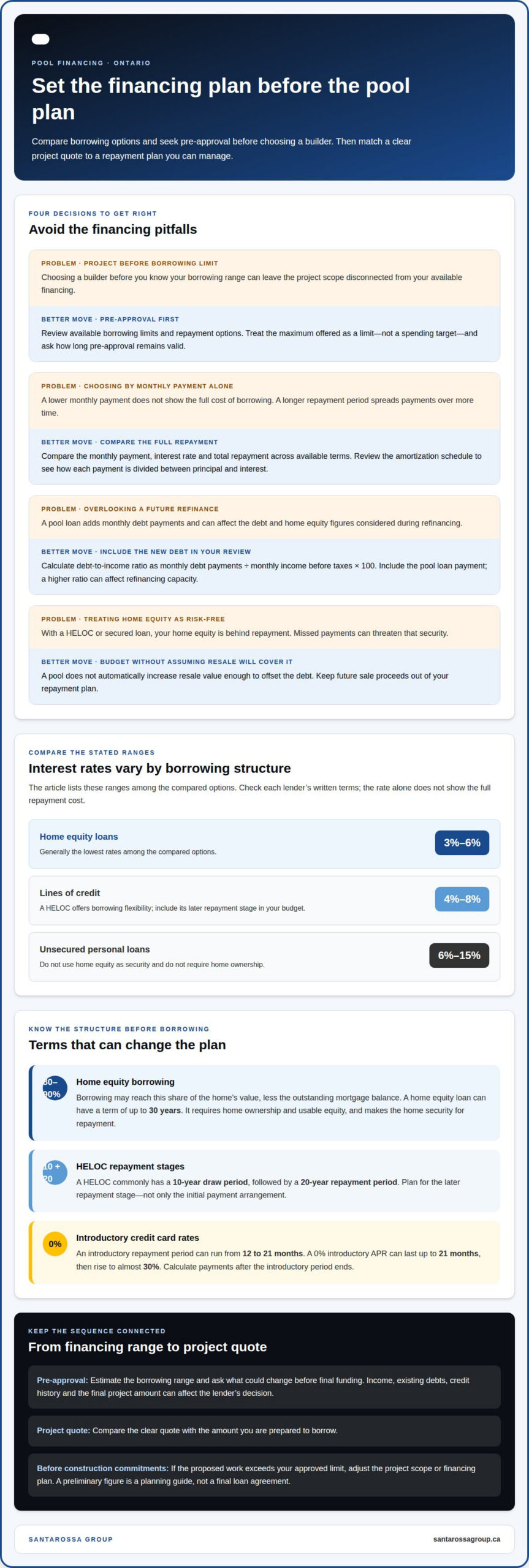
Start by submitting an application to understand the amount and repayment options available to you. Contractor repayment terms may extend up to 30 years. Compare the borrowing limit with your planned project scope, and avoid treating the maximum offered as a spending target.
-
Compare Repayment Periods and Costs
Compare the monthly payment, interest rate and total repayment across available terms. A longer repayment period spreads payments over more time, while a shorter one means paying back the loan sooner. Review the full amortization schedule, including how much of each payment goes to principal and interest. A lower monthly payment alone doesn’t reveal the full cost of borrowing.
- Use pre-approval to establish a financing range before choosing a builder. Then get a clear project quote and compare it with the amount you’re prepared to borrow. If the proposed work exceeds your approved limit, adjust the project scope or financing plan before making construction commitments. This connects the loan amount to the planned work, rather than an early estimate.
Ask how long pre-approval remains valid and what could change before final funding. Income, existing debts, credit history and the final project amount can affect a lender’s decision. Treat a preliminary figure as a planning guide, not a final loan agreement. The final application and lender terms determine the borrowing arrangement.
Will financing a pool impact my ability to refinance my home later?
A pool loan can affect the debt and equity figures considered during refinancing. Before borrowing, account for the monthly payments, potential credit impact and how the loan relates to your home.
-
Check Pre-qualification and Credit Impact
Start with pre-qualification to estimate your borrowing options before submitting a full application. Ask whether the initial review affects your credit score, since lenders use different inquiry processes. Credit scores can influence the rates borrowers are offered. Compare offers within a short planning period, and consider the credit impact before opening several accounts.
A credit card’s introductory repayment period can run from 12 to 21 months. A 0% introductory APR can last up to 21 months, then rise to almost 30%. Don’t base affordability on the introductory period alone; calculate the monthly payments after it ends.
-
Assess Debt and Home Equity Effects
Calculate your debt-to-income ratio by dividing monthly debt payments by monthly income before taxes, then multiplying by 100. Include the pool loan payment in your debts. A higher ratio can affect refinancing capacity, while the new borrowing also reduces available home equity. A pool doesn’t automatically increase resale value enough to offset that debt, so don’t treat future sale proceeds as a repayment plan.
Financing raises monthly housing costs through loan payments and interest. A HELOC commonly has a 10-year draw period followed by a 20-year repayment period. Include the later repayment stage in your budget, not just the initial payment arrangement.
- Compare financing structures before choosing. Home equity loans generally have the lowest rates among compared options, with a 3%-6% range; lines of credit are listed at 4%-8%, while unsecured personal loans are listed at 6%-15%. A HELOC offers borrowing flexibility, while personal loans don’t use home equity as security. With a HELOC or secured loan, the central risk is putting your home equity behind repayment; missed payments can threaten that security.
To keep the project scope connected to your financing plan, consider pool project planning alongside the borrowing decision.
Home equity loans
- Estimate available equity before choosing a home equity loan. This option requires home ownership, and borrowing may reach 80% to 90% of the home’s value, less the outstanding mortgage balance. For example, a homeowner with substantial mortgage debt has less available equity than someone with a smaller balance, even if both homes have the same value. A home equity loan can have a term of up to 30 years. Consider whether that repayment period fits your broader plans, including a future refinance. Using home equity may provide access to funds, but it also makes your home security for repayment.
- Compare a home equity loan with a personal loan using the same pool budget and repayment timeline. Personal loans don’t require home ownership, while home equity borrowing requires a home and usable equity. Review each offer’s interest rate, payment schedule and total repayment. A longer term can lower scheduled payments but keep the debt in place for longer. Choose the option that fits the project and your ability to repay.
- Assess each financing option by its written terms, not its name. If Lyon Financial appears in your research, compare its loan amount, interest rate, term and repayment schedule with other offers. A pool-focused name doesn’t guarantee a lower rate or suitable terms. For an inground pool, base the financing amount on the project quote and construction plan. Keep future upkeep separate from the installation budget so you can judge whether the loan will remain manageable after the build.
Financing a pool installation in Ontario
Choosing the best way to finance a pool installation in Ontario starts with matching the borrowing option to your project schedule and household budget. Compare the full cost of each option before committing.
- Compare financing structures against your intended timeline. Mortgage refinancing can free funds for installation and may offer lower interest rates, but it can involve additional fees. Unsecured personal loans and specialized pool financing loans have a 6%-15% interest-rate range. Credit cards and unsecured loans may carry higher rates than other options, so weigh total repayment costs, not just approval speed.
- Map payments against your household budget before choosing a flexible loan. Short-term loans have higher monthly payments but accrue less interest over time. Personal loans may have APRs from 6% to 36%, with the lowest rates often offered to borrowers with good or excellent credit. Lenders often require steady income. Use the lender’s payment schedule to assess whether the project remains manageable throughout construction and repayment.
- Include approvals, safety requirements and insurance in your planning. Permit processes and pool safety rules can vary by Ontario municipality and property, so account for them in the construction sequence. Discuss the planned pool with your insurer before work begins and understand any effect on your policy. Treat these as project-planning steps, not optional financing extras.
- Leave rebates, grants and tax credits out of your base budget unless a program clearly confirms your project is eligible. Don’t assume pool installation qualifies for financial assistance. Build your plan around confirmed loan terms and available funds, and treat any eligible assistance as a possible adjustment rather than money needed to complete construction.
- Before signing, align the lender’s release schedule with the project quote and construction sequence. This can help you plan when funds are available as the work progresses. To identify the best way to finance a pool installation in Ontario, connect the financing timeline to the project scope and your repayment plan. If you’re planning an inground pool, coordinate your pool project planning with the financing timeline.
Santarossa Group: Pool Installations
Santarossa Group provides pool installations, coordinating design, permitting and construction through one point of contact. When your financing plan is taking shape, the team can connect the project scope with a clear construction plan. This brings practical decisions, including site requirements and build sequence, into one managed process.
A defined project scope also makes it easier to compare financing with the planned work. Santarossa Group can discuss how a pool installation fits your property and construction priorities, giving you a clearer picture of the project before you commit.
If you’re ready to discuss a pool project, contact Santarossa Group.
Set Your Pool Plans in Motion
Turn your financing decision into a project plan that supports how you want to use your property. A pool can shape decisions about outdoor living and future home improvements, so consider how it fits alongside possible home additions, basement renovations or bathroom renovations. Keeping these priorities in view can help you make coordinated choices without rushing.
The best way to finance a pool installation in Ontario is the option that fits your household budget and the project you plan to build. A clear scope and thoughtful construction plan can help you move ahead with confidence while keeping longer-term home plans in view.
Plan your pool project with Santarossa Group, and take the next step when you’re ready.
Frequently Asked Questions
Can I roll pool financing into my mortgage?
Yes, mortgage refinancing can release funds for a pool project instead of leaving the pool debt as a separate loan. Refinancing may offer a lower interest rate than other borrowing options, but fees can apply. Compare its total cost with keeping the pool loan separate, including how the new mortgage payment fits your household budget and longer-term plans.
How Much Does It Cost to Finance a Swimming Pool?
Financing costs depend on the amount borrowed, interest rate, repayment period and applicable fees. Keep these borrowing costs separate from the pool’s construction price. A longer repayment schedule, for example, can increase the interest paid over time even if it lowers the scheduled payment. Compare the total repayment, not just the monthly instalment, before choosing an offer.
How much do in-ground pools cost?
There isn’t one price for every in-ground pool. The total depends on the pool type, design and site work. Concrete pools are generally the most expensive type, followed by vinyl and fibreglass. A larger or more elaborate design, landscaping, retaining walls and lighting can increase the total. Use a project-specific quote to set a sound financing amount.
What financing options are available for pool installation in Ontario?
Ontario homeowners can consider home equity loans, HELOCs, mortgage refinancing, unsecured personal loans, specialized pool loans and credit cards. These options differ in how funds are accessed, whether borrowing is secured against home equity, and how repayment works. A fixed loan provides a set amount, for example, while a line of credit lets you draw funds as needed. Compare each option’s terms with your project schedule.
What are typical interest rates, fees, and repayment terms for pool financing in Ontario?
Listed rates vary by product: home equity loans range from 3%-6%, lines of credit from 4%-8%, and unsecured personal or specialized pool loans from 6%-15%. Personal-loan APRs can range from 6% to 36%. Terms also differ: personal pool loans typically run 1-7 years, while home equity and contractor financing can extend up to 30 years. Fees depend on the financing structure.
Can pool installation costs be added to a mortgage or refinanced in Ontario?
Yes, mortgage refinancing can free up funds for pool installation. It may offer a lower interest rate than some alternatives, but fees add to the borrowing cost. The amount available depends on the lender’s assessment of your finances and property. Compare the revised mortgage balance and payment schedule with separate pool financing, and consider your future refinancing plans.