A renovation contractor in Windsor usually doesn’t need a provincial licence. Ordinary renovations don’t require an HCRA licence, but building or selling a new home does. Checking a contractor’s licence and insurance in Windsor means confirming the credentials required for the specific work, then reviewing liability insurance and current WSIB coverage.
It’s sensible to want clear proof before work begins, especially when a project involves specialized trades or several stages of construction. A WSIB clearance certificate should be no more than 90 days old while the contractor is working, and liability insurance should be confirmed with the insurer named on the certificate.
This guide explains Ontario’s general-contractor licensing rules, where to check trade registration, and how to confirm insurance and workers’ compensation clearance. Follow the steps to identify which checks apply to your project and understand what each result can tell you.
Key Takeaways
- Match the credentials you review to the work planned, especially when a project involves a regulated trade.
- Use a current WSIB clearance certificate to understand a contractor’s workers’ compensation status while work is underway.
- Review the certificate of insurance and confirm directly with the insurer that the policy is active and covers the project.
- Know which checks involve Ontario trade regulators and which licensing questions are handled by the City of Windsor.
What is a workers’ compensation clearance certificate and why does it matter?
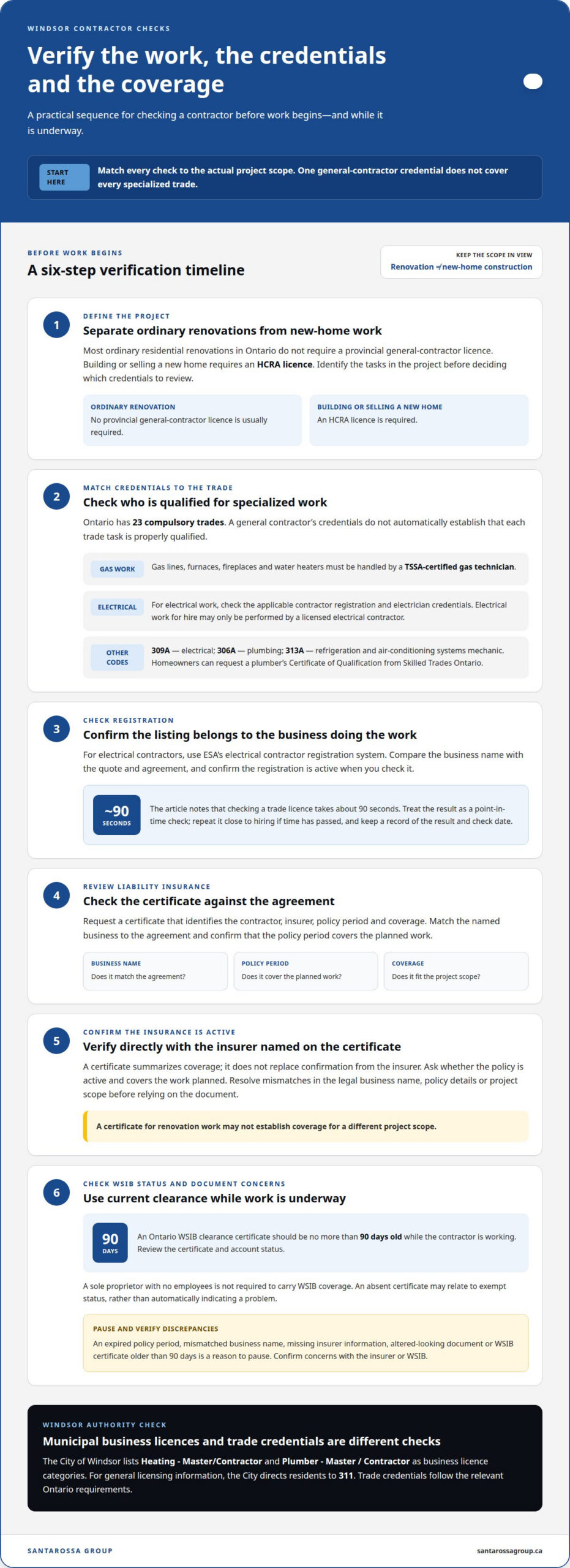
Most Ontario residential contractors don’t need a provincial licence for ordinary renovations; building or selling a new home requires an HCRA licence. Before work begins, ask for any applicable trade credentials, a liability insurance certificate and current WSIB clearance.
- Request a liability insurance certificate that identifies the contractor, insurer, policy period and coverage. Match the named business to the agreement, and make sure the policy period covers the planned work. A certificate summarizes coverage; it doesn’t replace confirmation from the insurer that the policy remains active.
- Review the contractor’s WSIB clearance certificate and account status. Ontario certificates should be no more than 90 days old while the contractor is working. A sole proprietor with no employees isn’t required to carry WSIB coverage, so an absent certificate may relate to exempt status rather than automatically indicating a problem.
-
Confirm coverage with the insurer
Contact the insurer named on the certificate to confirm the policy is active and covers the work planned. Check that the contractor’s legal business name and policy details match the document. For example, a certificate for renovation work may not establish coverage for a different project scope. Resolve any mismatch before relying on the certificate.
-
Watch for invalid documents
Compare the contractor’s name, policy dates and insurer details across the agreement and certificate. Treat an expired policy period, mismatched business name, missing insurer information or altered-looking document as a reason to pause. A WSIB certificate older than 90 days may also be out of date during the work. Confirm discrepancies with the insurer or WSIB.
- Match trade credentials to specialized work. Ontario gas lines, furnaces, fireplaces and water heaters must be handled by a TSSA-certified gas technician. For electrical work, verify the applicable contractor registration and electrician credentials; a general liability certificate doesn’t prove trade qualification.
Ontario general-contractor licensing rules
Most ordinary renovations in Ontario don’t require a provincial general-contractor licence; building or selling a new home does require an HCRA licence. If an uninsured or unlicensed contractor causes damage, document it with dated photographs, keep contracts and messages, and promptly notify your home insurer.
-
Review Ontario contractor licensing requirements
First, determine whether the project is an ordinary renovation or new-home construction. Most Ontario residential contractors don’t need a provincial licence for ordinary renovations, while building or selling a new home requires an HCRA licence. A general contractor’s lack of a provincial licence alone doesn’t show whether each part of the project has the required credentials. Identify the work involved, then check the credentials required for those tasks.
-
Identify compulsory trade licensing needs
Next, separate renovation work from regulated trade work. Ontario has 23 compulsory trades under the Building Opportunities in the Skilled Trades Act, 2021. People doing regulated trade work for pay may need to hold the relevant qualification. Electrical work for hire may only be performed by a licensed electrical contractor. Plumbing is compulsory; homeowners can request a Certificate of Qualification from Skilled Trades Ontario. For electrical work, the trade code is 309A; plumbing is 306A. For refrigeration and air-conditioning systems mechanics, the code is 313A. Match credentials to the actual scope, rather than assuming one general-contractor licence covers every trade. These distinctions help clarify which qualifications apply to renovation work and which apply to specialized tasks.
-
Find the licensing authority
Then identify whether the work falls under a City of Windsor business licence category or an Ontario trade requirement. Windsor lists Heating – Master/Contractor and Plumber – Master / Contractor as business licence categories. For general licensing information, the City directs residents to 311. Trade credentials follow their relevant Ontario requirements, so a municipal business licence and a trade qualification serve different purposes. Keep the authority and credential matched to the work being reviewed.
For a project involving Windsor renovation planning, define the renovation scope first. That helps distinguish general renovation work from compulsory trade tasks.
Checking a contractor’s active registration
Check with the regulator responsible for the trade, then match its registration details to the business doing the work. For electrical contractors in Ontario, ESA registration is a practical place to start. Treat registration as one part of checking a contractor’s licence and insurance in Windsor, not proof that every project requirement is covered.
- Search the contractor’s business name through ESA’s electrical contractor registration system. Compare the result with the name on the quote and agreement. A similar name isn’t enough to establish that the listing belongs to the business you’re considering. Resolve differences in spelling, legal name or identifying details before relying on the result.
- Confirm that the registration is active when you review it. Checking a trade licence takes about 90 seconds. Treat this as a point-in-time check, and repeat it close to hiring if time has passed. Keep a record of the result and check date, so you can refer back to the same registration details. This record also helps if the proposed scope changes.
- Match the credential to the actual work. ESA registration relates to electrical contractors, not every renovation task. For electrical work, the contractor must hold an ECRA licence, and the work must be done by or supervised by a licensed electrician holding a 309A certificate. A general contractor’s listing alone doesn’t establish that the electrical work has the required credentials.
- Use the right regulator for other specialized work. Ontario gas contractors can be checked through TSSA credentials; plumbing is a compulsory trade, with a separate qualification from electrical registration. If the project includes electrical, gas or plumbing work, identify who performs each task and match credentials to that scope before hiring. This makes checking a contractor’s licence and insurance in Windsor more specific to the work planned.
- Keep the result in context. Registration can help a homeowner verify a trade credential, but it doesn’t assess workmanship, confirm insurance coverage or establish that every part of a renovation is regulated. Record the business name, registration details and check date alongside project documents. That gives you a clear reference if the contractor or work scope changes before construction begins.
Which Windsor or Ontario authority regulates contractor licences?
Start with the work involved: Windsor business licences and Ontario trade credentials are handled through different systems. Match each question to the authority responsible for that credential.
- For a municipal business licence, consult the City of Windsor’s licensing information. Its listed categories include Heating – Master/Contractor and Plumber – Master / Contractor. For general licensing information, the City directs residents to 311. A municipal business licence category is distinct from a trade certificate or registration, so identify which credential you’re checking.
- Use the City’s by-law framework when your question concerns a Windsor business licence. The relevant business licensing by-law is 395-2004. The City’s licensing regulations also include Public Vehicle Licensing By-law 137-2007, as amended by By-law 150-2018, and Body Rub Parlour By-Law 131-2011. These cover different licensing subjects, so focus on the category relevant to the contractor’s work.
- For electrical contractor status, check the Ontario electrical contractor registration system. Electrical contractors must hold an ECRA licence, and the electrical work must be done by or supervised by a licensed electrician holding a 309A certificate. This separates the contractor’s business licence from the electrician’s trade credential. Check the right record for the role being performed.
- For gas work, check the contractor’s TSSA credentials. Ontario gas lines, furnaces, fireplaces and water heaters must be handled by a TSSA-certified gas technician. For plumbing, distinguish the City’s Plumber – Master / Contractor business licence category from the trade qualification required for compulsory trade work. Each answers a different licensing question.
- For general building-permit questions, contact the municipality responsible for the property. Ontario building permits are issued by municipalities under the Ontario Building Code. In Windsor, ask 311 for general licensing information, and direct permit questions to the municipal building department. This keeps local licensing enquiries separate from province-wide trade credential checks.
Planning a renovation in Windsor? Discuss your project plans as you organize the work and its required approvals.
Santarossa Group
Santarossa Group helps Windsor homeowners move from contractor checks to a clearly planned renovation. For Home Additions, Basement Renovations, Bathroom Renovations and Kitchen Renovations, the team manages design, permitting and construction, with one point of contact throughout the project.
Once you know which credentials apply, bring the project scope and your priorities into the planning conversation. This helps organize the next steps and clarify how the renovation will proceed. For a home project in Windsor, Santarossa Group can help shape your plans into a coordinated project.
Contact Santarossa Group to discuss your renovation.
Make the next project decision with confidence
Checking a contractor’s licence and insurance in Windsor is one part of planning well. Next, define the project scope and gather your priorities and questions before arranging the work. This gives you a clearer starting point for discussing responsibilities and the decisions that will shape your home.
If you’re considering Home Additions, Basement Renovations or Bathroom Renovations in Windsor, Santarossa Group can help turn your plans into a coordinated project. Consider how you want the finished space to function, what needs to change and which details matter most to your household. A focused conversation about these priorities helps make planning more useful and gives you a clear next step.
Start planning your project with Santarossa Group, and take the next step with a clearer sense of direction.
Frequently Asked Questions
Do renovation contractors need a licence in Canada?
Licensing rules vary across Canada, so requirements depend on the province and project. In Ontario, ordinary home renovations generally don’t require a provincial general-contractor licence, while building or selling a new home requires an HCRA licence. A renovation may still involve regulated trades. For example, electrical work for hire has separate contractor and electrician credential requirements.
How much liability insurance should a renovation contractor carry?
The appropriate level of liability coverage depends on the project’s scope and potential exposure. For residential projects over C$25,000, the recommendation is C$2 million. Treat these as guidance for assessing coverage, not as a universal legal requirement. The project’s scope and potential exposure matter, so confirm that the policy covers the specific work being done.
Is a solo contractor without workers’ compensation coverage a problem?
Not necessarily. Ontario sole proprietors with no employees aren’t required to carry WSIB coverage. An independent operator working alone on an existing private residence, hired and paid directly by the homeowner, may also be exempt from covering themselves. If a clearance certificate isn’t available, clarify the contractor’s status with WSIB rather than assuming its absence proves non-compliance.
How do I verify a contractor’s licence in Windsor, Ontario?
First identify the trade and business credential relevant to the work. Electrical contractor registration can be checked through ESA; gas contractor credentials are checked through TSSA. For City of Windsor business licensing questions, call 311. These checks answer different questions, so a municipal business licence shouldn’t be treated as proof of a regulated trade qualification.
How can I check a contractor’s WSIB clearance certificate in Ontario?
Use WSIB’s online clearance lookup to review the contractor’s account and clearance status. The lookup takes about 2 minutes. Check that the certificate is current during the work; Ontario clearance certificates should be no more than 90 days old while the contractor is working. If the contractor says they’re exempt, confirm the status directly with WSIB.
What insurance should a Windsor contractor carry, and how can I verify it?
Ask for a certificate of liability insurance, then contact the named insurer to confirm the policy is active and covers the planned work. Compare the insured business name and policy period with the agreement. The certificate provides useful documentation, while confirmation from the insurer helps establish that coverage remains in effect for the project.